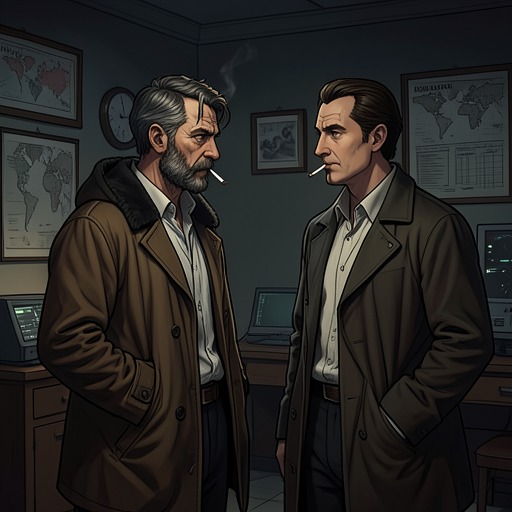
Bromden lifts the hydrotherapy control panel
One Flew Over the Cuckoo's NestBromden lifts the hydrotherapy control panel in a sequence that turns a private promise into a public wager. The feat demonstrates that Chief Bromden’s strength has returned, but its second performance also makes him feel responsible for the money the other patients lose. The panel thus becomes both a physical test and the instrument of a shift in trust: McMurphy knows what Chief can do, while the men he bets against do not.
The Promise and the Test
The action begins with McMurphy asking whether Chief, at his former size—six feet seven or eight and about 280 pounds—could have lifted the control panel in the tub room. Chief recalls lifting objects of comparable weight in the Army and says he probably could have done so then. Asked whether he could manage it if he became that big again, he thinks he could. McMurphy insists on a promise, not a guess: if Chief will lift the panel after regaining his strength, McMurphy will give him a special bodybuilding course and a ten-dollar fishing trip at no cost.
McMurphy treats the proposed restoration as a secret, warning Chief that such knowledge could be dangerous in an enemy’s hands and saying Chief might not notice it happening. The promise therefore precedes any visible proof. Chief agrees to the test without yet knowing how McMurphy expects to make him strong again. The bargain joins physical recovery to the fishing trip and to McMurphy’s characteristic confidence, while leaving the supposed method unexplained in this episode.
After the fishing trip, McMurphy points out that Chief seems to have grown ten inches. He calls attention to the apparent size of Chief’s foot and arm, then urges him to test his strength on the panel. Chief refuses at first, but McMurphy reminds him of their deal. Chief approaches the levers intending only to show that he cannot lift it. Under McMurphy’s instructions to straighten his legs and raise the panel, he does lift it. When Chief steps back, the panel is no longer seated in its mooring; it has shifted about half a foot. McMurphy is grinning, and he tells Chief to put it back so no one will know.
From Private Feat to Public Wager
McMurphy does not tell the other men that Chief has already raised the panel. Instead, after a meeting, he steers conversation during the pinochle games toward strength, physical power, and the tub-room control panel. Dale Harding asks whether McMurphy is ready to try lifting it again. McMurphy declines, while leaving open the possibility that the feat could be done. Scanlon suggests a crane; McMurphy accepts that a man might not be able to lift it alone, but does not rule out the possibility.
Chief watches McMurphy let the men arrive at the claim that no living man could lift the panel, and then allow them to propose the wager themselves. McMurphy appears reluctant to bet. That performance helps the odds grow: he waits until each man offers him five to one, and some stake as much as twenty dollars. The crucial concealed fact is not that the panel can be lifted, but that McMurphy has already seen Chief lift it. His silence converts Chief’s private demonstration into an advantage in the betting.
Chief hopes McMurphy will abandon the plan. The following day, the nurse announces that everyone who went on the fishing trip must take special showers because the group is suspected of having vermin. Chief hopes the showers will happen immediately, or that something else will prevent the test. The announcement adds urgency: if the tub room is locked before the men can reach the panel, the wager cannot be settled as planned. Once the meeting ends, McMurphy leads Chief and the others into the room before the black boys can lock it up.
The Lift and Its Cost
This time Chief knows that the whole group is watching and that the lift will decide the bets. He does not want to perform it, and he feels he cannot refuse. He takes hold of the levers and raises the panel again. The other men are friendly with McMurphy as they pay, but Chief believes they feel that something has been knocked out from under them. Their outward good humor does not erase his awareness that they have lost money through a wager whose decisive evidence McMurphy kept from them.
After replacing the panel, Chief runs to the latrine without looking at McMurphy. He wants to be alone and sees himself in the mirror. There he recognizes a body he had thought diminished: his arms are large again, as they were in high school and back at the village, and his chest and shoulders are broad and hard. The mirror gives him a direct confirmation that the earlier lift was more than a successful effort in front of McMurphy. His sense of renewed strength rests on his own visible body.
McMurphy follows him into the latrine and offers him a five-dollar bill as chew-gum money. Chief shakes his head and starts to leave; McMurphy catches him by the arm. The evidence establishes the offer and Chief’s refusal, but not what follows. The gesture leaves the two dimensions of the episode unresolved beside each other: McMurphy has made money from the demonstration, while Chief’s recovery cannot be reduced to a share of that money.
Significance
The control panel changes meaning across the sequence. At first it is a measure of strength invoked in a private bargain; after Chief lifts it once, it becomes proof that McMurphy withholds while inviting the other men to risk their money. Its shift from the mooring by half a foot is a small but concrete trace of what the men are told cannot be done. The later public lift repeats the act, but repetition changes its emotional charge: the first confirms McMurphy’s confidence in Chief, while the second makes Chief feel implicated in the others’ losses.
Chief’s response also distinguishes physical recovery from uncomplicated triumph. The mirror offers him evidence of renewed size and strength, yet he does not celebrate with McMurphy or accept the money. He leaves the tub room in distress and seeks solitude. The action therefore binds a visible bodily change to an uneasy social consequence: McMurphy’s wager makes Chief’s strength legible to the ward, but the terms of that display leave Chief divided between the proof of his own recovery and his discomfort at how it has been used.